Word That Means to Make Eveyrthing Right Again
Is this the most powerful word in the English linguistic communication?
The most normally-used discussion in English might only accept three letters – only information technology packs a punch.
'The'. It's omnipresent; we can't imagine English without it. But information technology's not much to look at. Information technology isn't descriptive, evocative or inspiring. Technically, it's meaningless. And yet this bland and innocuous-seeming word could exist one of the virtually potent in the English language language.
This story was originally published in January 2020.
More than similar this:
- The surprising history of the discussion 'dude'
- The story of handwriting in 12 objects
- What a single sound says about you
'The' tops the league tables of virtually oft used words in English, accounting for 5% of every 100 words used. "'The' really is miles higher up everything else," says Jonathan Culpeper, professor of linguistics at Lancaster University. Simply why is this? The reply is ii-fold, co-ordinate to the BBC Radio 4 programme Give-and-take of Oral cavity. George Zipf, a 20th-Century The states linguist and philologist, expounded the principle of least endeavor. He predicted that brusque and simple words would be the most frequent – and he was correct.
The second reason is that 'the' lies at the heart of English grammar, having a role rather than a meaning. Words are carve up into 2 categories: expressions with a semantic meaning and functional words like 'the', 'to', 'for', with a job to do. 'The' tin function in multiple means. This is typical, explains Gary Thoms, assistant professor in linguistics at New York University: "a super high-usage word volition oft develop a existent flexibility", with dissimilar subtle uses that brand it hard to define. Helping us sympathise what is being referred to, 'the' makes sense of nouns as a subject or an object. So even someone with a rudimentary grasp of English can tell the difference between 'I ate an apple' and 'I ate the apple tree'.

'Scoring the goal' seems more than important than 'scoring a goal' (Credit: Alamy)
Just although 'the' has no meaning in itself, "it seems to exist able to do things in subtle and miraculous means," says Michael Rosen, poet and writer. Consider the difference betwixt 'he scored a goal' and 'he scored the goal'. The inclusion of 'the' immediately signals something important about that goal. Peradventure information technology was the merely 1 of the friction match? Or possibly information technology was the clincher that won the league? Context very oft determines sense.
In that location are many exceptions regarding the use of the definite commodity, for example in relation to proper nouns. We wouldn't expect someone to say 'the Jonathan' but it's non incorrect to say 'you're non the Jonathan I thought yous were'. And a football commentator might deliberately create a generic vibe by maxim, 'you've got the Lampards in midfield' to mean players similar Lampard.
The use of 'the' could take increased as trade and industry grew in the run-up to the industrial revolution, when we needed to be referential virtually things and processes. 'The' helped distinguish conspicuously and could act every bit a quantifier, for instance, 'the slab of butter'.
This could lead to a conventionalities that 'the' is a workhorse of English; functional merely boring. Yet Rosen rejects that view. While primary school children are taught to use 'wow' words, choosing 'exclaimed' rather than 'said', he doesn't call up whatever word has more or less 'wow' factor than any other; it all depends on how it'southward used. "Power in linguistic communication comes from context... 'the' can be a wow word," he says.
This simplest of words tin can exist used for dramatic effect. At the start of Hamlet, a guard'southward utterance of 'Long live the Rex' is soon followed past the apparition of the ghost: 'Looks it non like the King?' Who, the audience wonders, does 'the' refer to? The living King or a dead Male monarch? This kind of ambiguity is the kind of 'claw' that writers use to make u.s.a. quizzical, a chip uneasy even. "'The' is doing a lot of work here," says Rosen.
Deeper pregnant
'The' can fifty-fifty have philosophical implications. The Austrian philosopher Alexius Meinong said a denoting phrase similar 'the round square' introduced that object; in that location was now such a thing. According to Meinong, the word itself created non-existent objects, arguing that there are objects that exist and ones that don't – just they are all created by language. "'The' has a kind of magical property in philosophy," says Barry C Smith, director of the Institute of Philosophy, University of London.
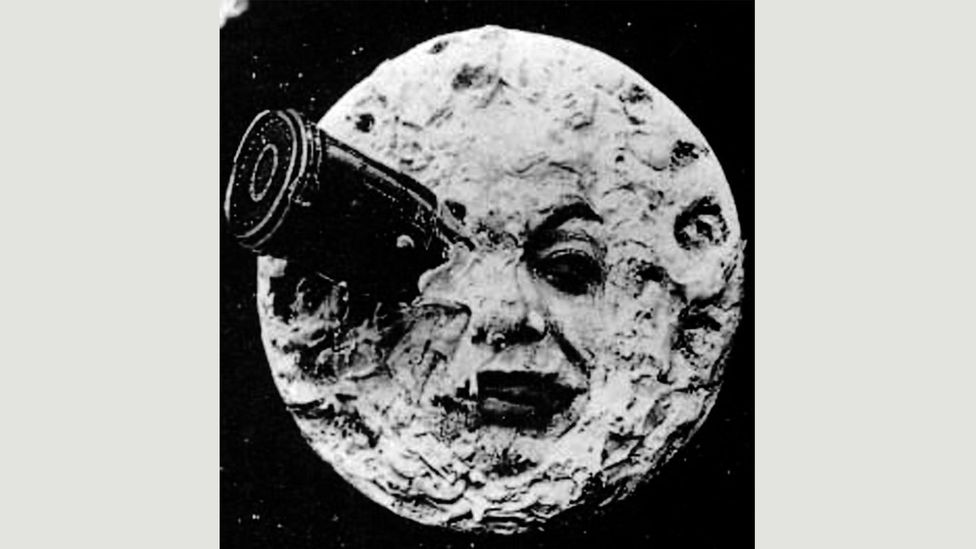
'The' adds substance to phrases like 'the man in the Moon', implying that he exists (Credit: Alamy)
The British philosopher Bertrand Russell wrote a paper in 1905 chosen On Denoting, all almost the definite article. Russell put forward a theory of definite descriptions. He idea it intolerable that phrases like 'the man in the Moon' were used every bit though they actually existed. He wanted to revise the surface grammer of English, as it was misleading and "not a good guide to the logic of the linguistic communication", explains Smith. This topic has been argued nigh, in a philosophical context, ever since. "Despite the simplicity of the word," observes Thoms, "it's been evading definition in a very precise way for a long time."
Lynne Murphy, professor of linguistics at the Academy of Sussex, spoke at the Boring Conference in 2019, an result celebrating topics that are mundane, ordinary and overlooked, but are revealed to exist fascinating. She pointed out how strange it is that our most commonly used give-and-take is i that many of the globe'southward languages don't have. And how amazing English language speakers are for getting to grips with the myriad means in which it'due south used.
Scandinavian languages such every bit Danish or Norwegian and some Semitic languages like Hebrew or Arabic use an affix (or a brusque add-on to the terminate of a word) to determine whether the speaker is referring to a item object or using a more full general term. Latvian or Indonesian deploy a demonstrative – words like 'this' and 'that' – to practice the chore of 'the'. In that location's another group of languages that don't utilise any of those resources, such as Urdu or Japanese.
Part words are very specific to each language.
Word of Oral cavity
So, someone who is a native Hindi or Russian speaker is going to accept to think very differently when constructing a sentence in English. Murphy says that she has noticed, for case, that sometimes her Chinese students hedge their bets and include 'the' where it is not required. Conversely, Smith describes Russian friends who are so unsure when to employ 'the' that they sometimes leave a trivial intermission: 'I went into... banking company. I picked upward... pen.' English language speakers learning a language with no equivalent of 'the' also struggle and might overcompensate by using words like 'this' and 'that' instead.
Atlantic divide
Even within the language, in that location are subtle differences in how 'the' is used in British and American English, such equally when talking about playing a musical instrument. An American might exist more likely to say 'I play guitar' whereas a British person might opt for 'I play the guitar'. Simply in that location are some instruments where both nationalities might happily omit 'the', such equally 'I play drums'. Equally the same person might interchangeably refer to their playing of any given instrument with or without the definite article – because both are correct and both make sense.
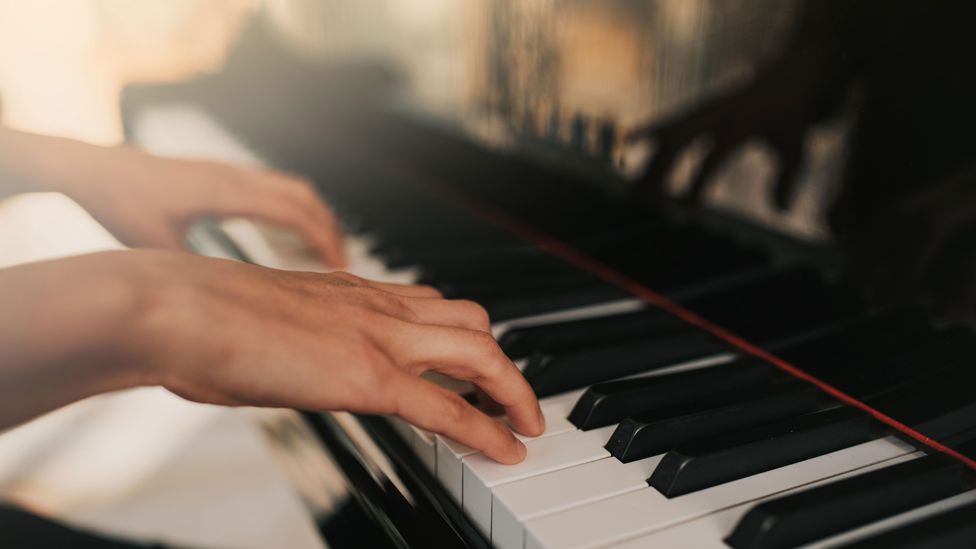
Americans are more than likely to say 'I play piano', whereas a Brit would probably say 'I play the piano' (Credit: Alamy)
And yet, keeping with the musical vibe, there's a subtle difference in meaning of 'the' in the phrases 'I play the piano' and 'I clean the piano'. We instinctively sympathise the former to mean the pianoforte playing is general and not restricted to one musical instrument, and yet in the latter we know that it is ane specific piano that is being rendered spick and span.
Culpeper says 'the' occurs virtually a 3rd less in spoken communication. Though of course whether it is used more frequently in text or speech depends on the discipline in question. A more personal, emotional topic might have fewer instances of 'the' than something more than formal. 'The' appears almost often in academic prose, offering a useful word when imparting data – whether it's scientific papers, legal contracts or the news. Novels use 'the' least, partly because they have conversation embedded in them.
According to Culpeper, men say 'the' significantly more often. Deborah Tannen, an American linguist, has a hypothesis that men deal more than in report and women more in rapport – this could explain why men apply 'the' more than often. Depending on context and background, in more than traditional power structures, a adult female may also have been socialised not to take the vocalisation of authority so might employ 'the' less oftentimes. Though whatsoever such gender-based generalisations also depend on the nature of the topic beingness studied.
Those in college status positions also utilize 'the' more – it can exist a point of their prestige and (self) importance. And when we talk almost 'the prime minister' or 'the president' it gives more power and authority to that office. It can also give a concept credibility or push an agenda. Talking about 'the greenhouse event' or 'the migration problem' makes those ideas definite and presupposes their existence.
'The' can exist a "very volatile" word, says Irish potato. Someone who refers to 'the Americans' versus simply 'Americans' is more than likely to be critical of that detail nationality in some capacity. When people referred to 'the Jews' in the build-upward to the Holocaust, it became othering and objectifying. According to Murphy, "'The' makes the group seem similar it's a large, uniform mass, rather than a diverse group of individuals." It's why Trump was criticised for using the word in that context during a 2016 U.s. presidential argue.
Origins
Nosotros don't know exactly where 'the' comes from – it doesn't have a precise antecedent in Old English grammar. The Anglo Saxons didn't say 'the', but had their own versions. These haven't completely died out, according to historical linguist Laura Wright. In parts of Yorkshire, Lancashire and Cumberland there is a remnant of One-time English language inflective forms of the definite article – t' (equally in "going t' pub").
The letter y in terms similar 'ye olde tea shop' is from the sometime rune Thorn, part of a writing system used beyond northern Europe for centuries. Information technology'southward only relatively recently, with the introduction of the Roman alphabet, that 'th' has come into being.
'The' deserves to be celebrated. The three-letter word punches well above its weight in terms of bear upon and latitude of contextual meaning. It can be political, it tin can exist dramatic – it tin fifty-fifty bring non-existent concepts into existence.
You lot can hear more about 'the' on BBC Radio 4'southward Word of Mouth: The Virtually Powerful Word.
If you would like to comment on this story or anything else you have seen on BBC Civilization, head over to our Facebook folio or message united states of america on Twitter .
And if you liked this story, sign upwardly for the weekly bbc.com features newsletter , called The Essential List. A handpicked option of stories from BBC Future, Culture, Worklife and Travel, delivered to your inbox every Friday.
Source: https://www.bbc.com/culture/article/20200109-is-this-the-most-powerful-word-in-the-english-language

Post a Comment for "Word That Means to Make Eveyrthing Right Again"